Executive Automation: Building Real Partnerships with AI
Moving beyond chat windows to proactive AI agent fleets that actually handle the heavy lifting of executive work.
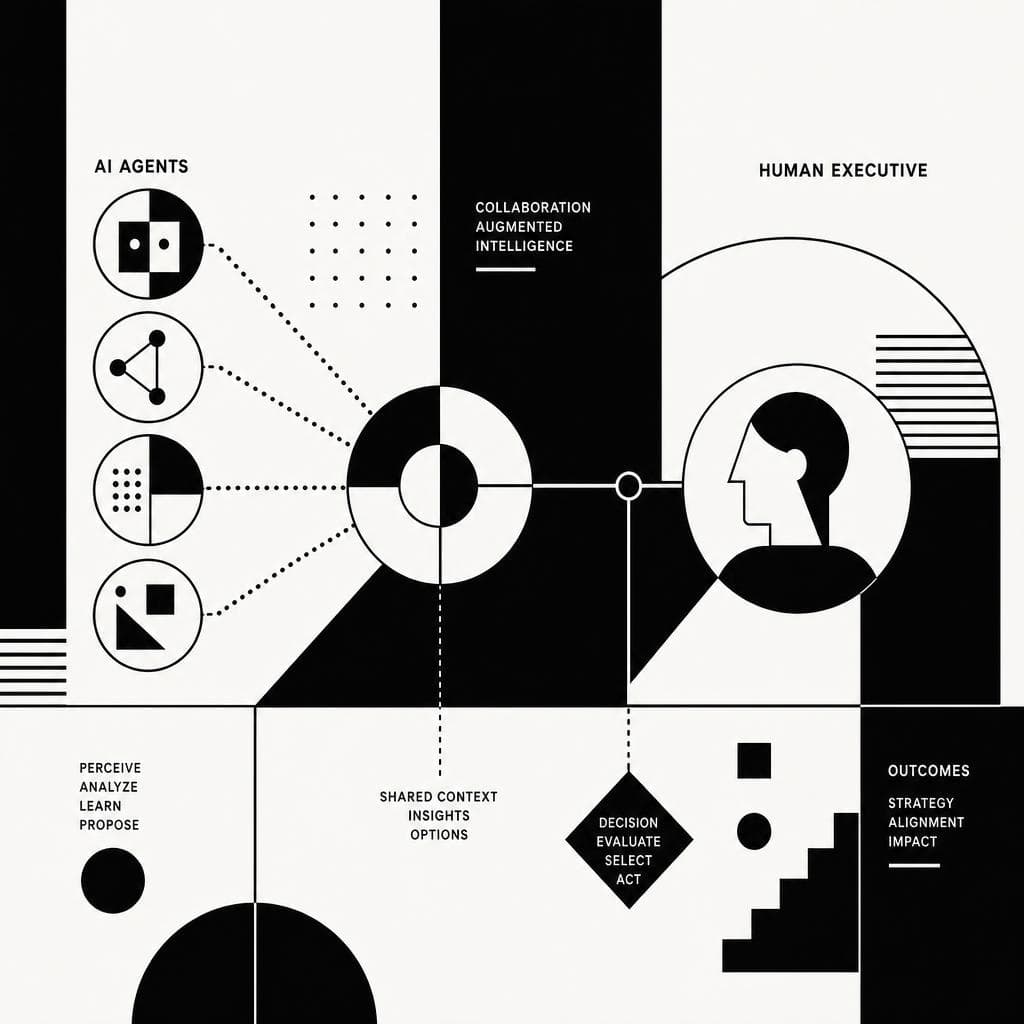
Let\'s get right to the point. Most executive use of AI today is stuck in a reactive loop. You open a chat window, you ask a question, you get an answer. It\'s better than a search engine, but it is not automation. It\'s just a faster way to do research.
Real executive automation requires a shift from AI as a tool to AI as a partner. I did not build Mira to replace judgment. I built her to extend reach—so I am less consumed by work that does not require me and more present in decisions that do.
The Reactive Trap
The trap is thinking that a better prompt is the solution. It isn\'t. The solution is infrastructure. Reactive AI saves minutes. Proactive AI infrastructure saves hours per week and compounds over time. When your AI system is waiting for you to tell it what to do, you are still the bottleneck.
Building the Fleet
In my experience building autonomous content and research fleets, the breakthrough happens when you define specific roles for your agents. You don\'t want one "AI Assistant." You want a researcher, a drafter, a reviewer, and a publisher. Each agent should have a narrow scope and a clear set of verification rules.
This is exactly what we implemented with our Mira Agent Hierarchy. By separating the roles, we created a system where trust is built into the architecture, not just the output.
- Agent A (Researcher): Scours data sources and identifies trends.
- Agent B (Strategist): Maps those trends to business objectives.
- Agent C (Reviewer): Audits the strategy against security and brand guidelines.
Trust but Verify
Trust but verify is not a defensive posture. It is the correct posture for working with any system that is operating near the edge of what it can do. The edge is where the useful work happens. Verification is what makes it safe to stay there.
Every piece of content published through my fleet goes through a verification layer. We don\'t just check for grammar; we check for data accuracy and voice alignment. If the system can\'t verify the data, the process stops. That\'s not a failure; that\'s a successful safety check.
The Practical Result
The practical result: routine work happens without being asked. I wake up to a research brief that was generated while I slept. I review a draft that is already 80% aligned with my voice. I am spending more time on the 20% that requires my specific experience and intuition.
If you are still typing "summarize this email" into a chat box, you are leaving the real value of AI on the table. The goal isn\'t to chat with your computer. The goal is to build a system that works for you while you are doing something else.
Getting Started
Getting started looks like this: pick one routine task that takes you more than 30 minutes a week. Map the steps. Identify where you apply judgment versus where you apply process. Automate the process. Build a verification step for the judgment.
The transition to an AI-partnered executive model is not a single jump. It\'s a series of small, intentional builds that eventually form a fleet. Start building yours today.